
-
By 2026, Måneskin ignites a global renaissance, blending rebellion and elegance, conquering stadiums, redefining rock’s future, and proving fearless authenticity can still dominate pop culture worldwide with style, fire, unity
By 2026, Måneskin Become the Loudest Truth of a Restless Generation
By the time the world reached 2026, it was no longer a question of whether Måneskin would survive the fast, brutal cycles of modern music. The real question was how deeply they would reshape it. What began years earlier as a raw, rebellious spark from Rome had grown into a global firestorm—one that refused to burn out, refused to soften, and refused to ask for permission.
In 2026, Måneskin are no longer just a rock band. They are a movement.
The four-piece—Damiano David, Victoria De Angelis, Thomas Raggi, and Ethan Torchio—stand at a rare intersection of mainstream dominance and underground credibility. In an era obsessed with algorithms, virality, and disposable hits, Måneskin represent something almost radical: longevity built on identity. Their music doesn’t chase trends; it confronts them. Their image doesn’t beg for approval; it dares the audience to keep up.
What makes their 2026 story so compelling is not simply success, but evolution without betrayal. Many bands lose their edge once stadiums replace clubs. Måneskin did the opposite. Their sound grew heavier, more experimental, and more emotionally precise. Guitars scream louder, basslines grow darker, drums hit with ritual intensity—and yet the hooks remain undeniable. You can still scream the lyrics at the top of your lungs, whether you’re in Milan, Lagos, São Paulo, or Los Angeles.
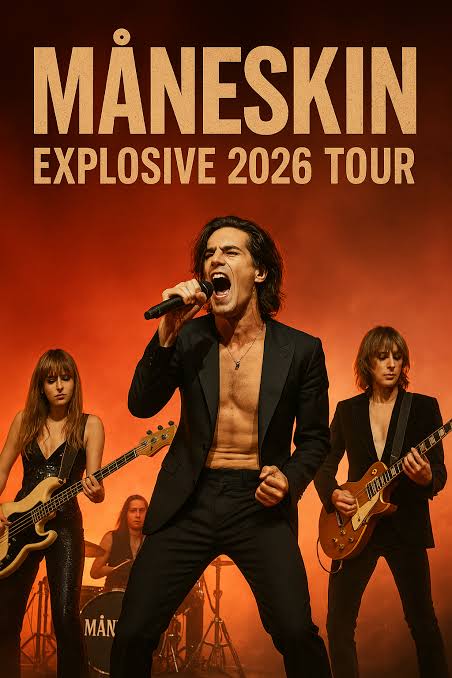
Their 2026 world tour is already being called one of the defining live experiences of the decade. Not because of fireworks or overproduction, but because of presence. Måneskin don’t perform at crowds; they collide with them. Each show feels like a shared confession—sweat, chaos, vulnerability, and freedom merging into something almost sacred. Damiano’s voice moves effortlessly from seductive whisper to primal roar, while Victoria’s bass remains the spine of the entire experience: confident, fearless, unapologetically feminine in a genre that once tried to silence that power.
Beyond the music, Måneskin’s cultural impact in 2026 is impossible to ignore. Fashion houses don’t just dress them; they study them. Young artists don’t just admire them; they model courage after them. Gender norms, language barriers, and rigid genre labels all feel smaller in their presence. They sing in multiple languages without explanation. They wear what they want without defense. They exist loudly in a world that often demands silence or conformity.
What truly sets Måneskin apart in this “future now” era is their honesty. Their lyrics in 2026 are sharper, more introspective, and unafraid of discomfort. They sing about fame’s emptiness, desire’s contradictions, mental exhaustion, political disillusionment, and the hunger to feel real in a digital age. There is no false optimism, but also no surrender. The message is clear: life is messy, and that mess deserves a soundtrack.
Critics who once dismissed them as a flashy revival act have long gone quiet. You can’t fake relevance for this long. You can’t manufacture this level of global connection. Måneskin’s audience spans generations—teenagers discovering rock for the first time and older listeners rediscovering why it once mattered so much. In 2026, they stand as proof that rock didn’t die; it simply needed artists brave enough to strip it naked again.
Perhaps the most powerful part of their story is how they carry their roots. Despite global fame, they never abandoned where they came from—or who they are. Interviews remain blunt. Performances remain dangerous. Success hasn’t polished away their hunger; it has sharpened it. They still sound like four friends who believe music should mean something, even when the world tells you meaning doesn’t sell.
In a time defined by uncertainty—political tension, cultural fragmentation, creative burnout—Måneskin offer something rare: unity through defiance. Not the kind that preaches, but the kind that invites. Their concerts feel like temporary nations, built on sweat, sound, and shared rebellion. No flags. No borders. Just noise and truth.
By 2026, history is already placing them carefully. Not as a nostalgia act. Not as a trend. But as a band that arrived when authenticity felt endangered—and chose to protect it with distortion, eyeliner, courage, and unfiltered sound.
Måneskin didn’t just predict the future of rock.
They forced it to show up—loud, imperfect, and gloriously alive.